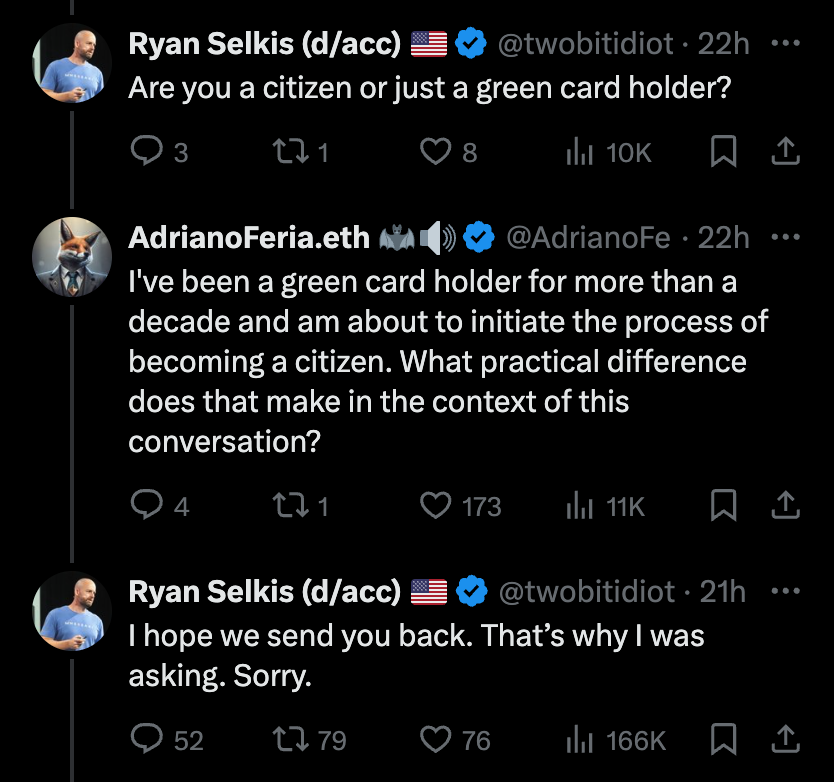
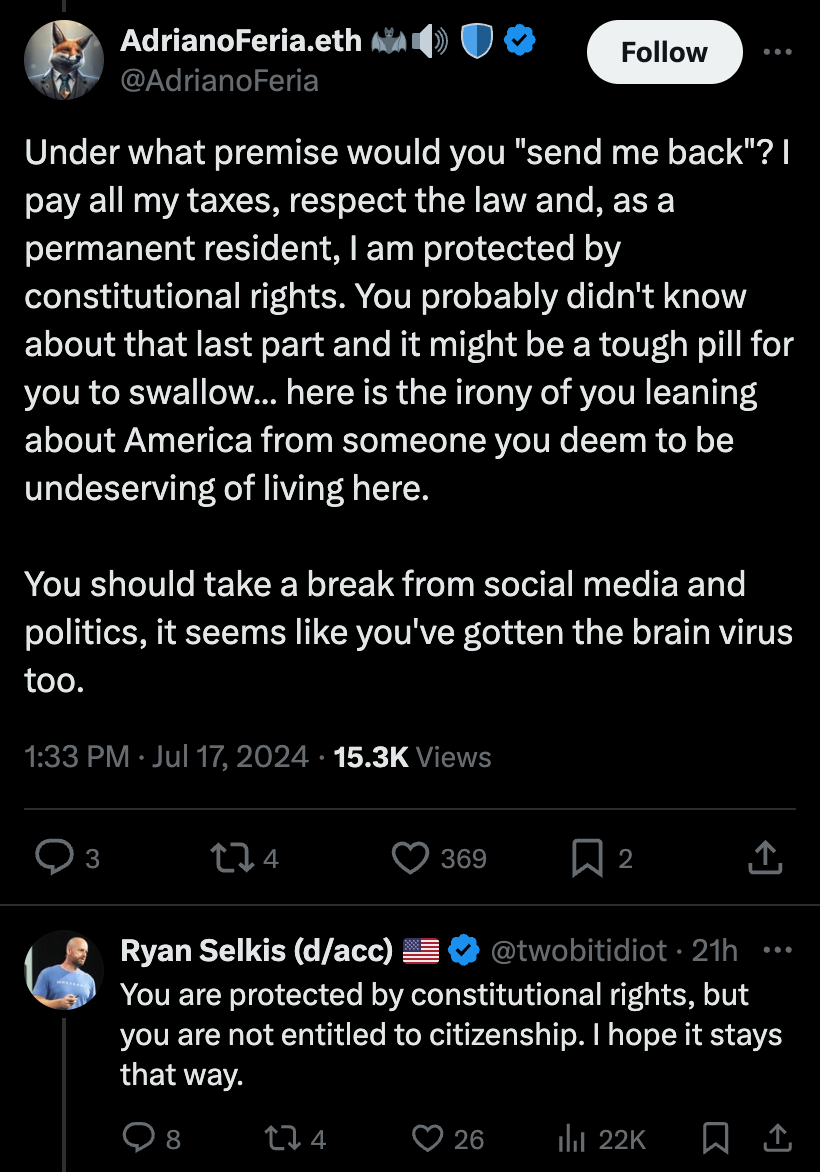
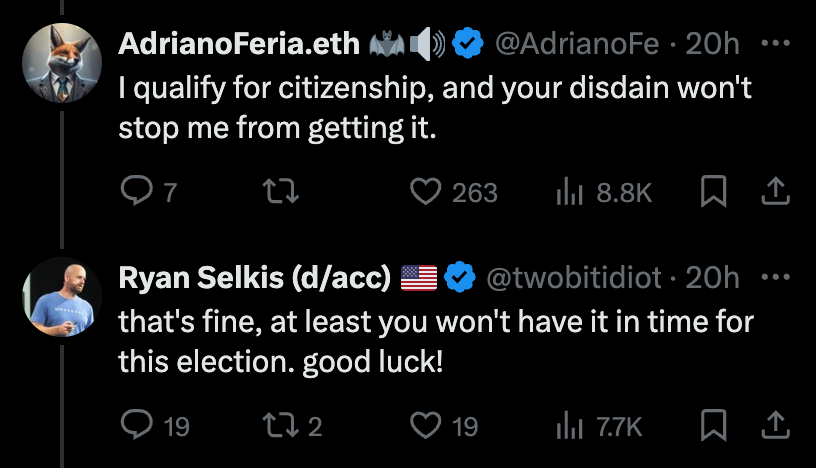
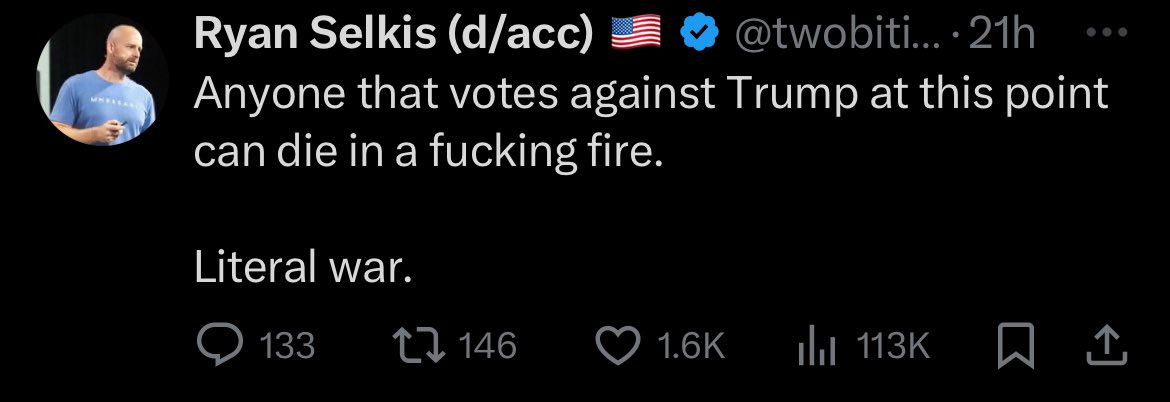
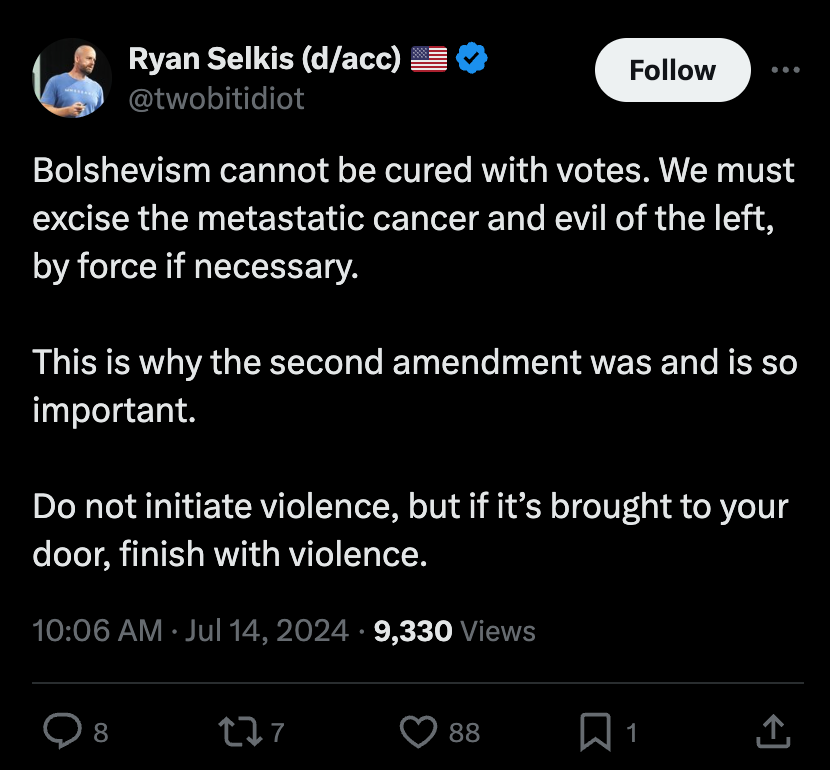
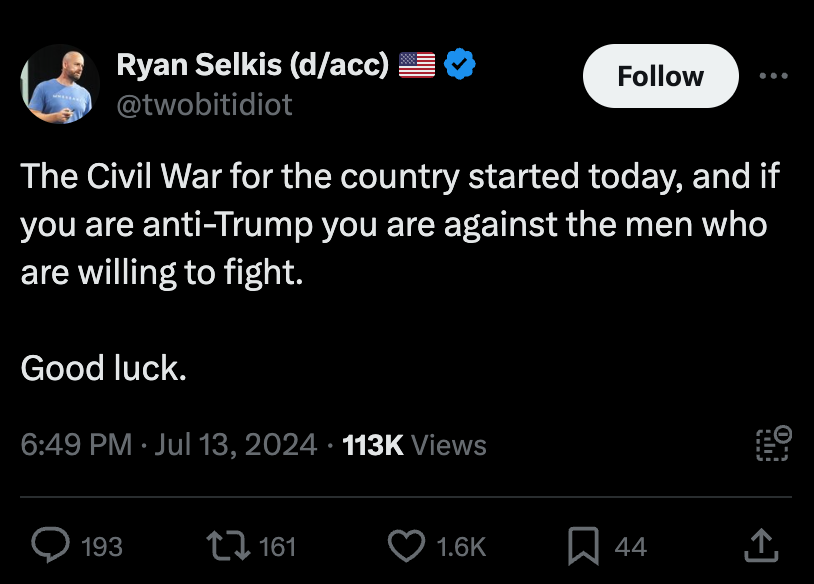
Some recent tweets from the founder and CEO of a prominent cryptocurrency company.
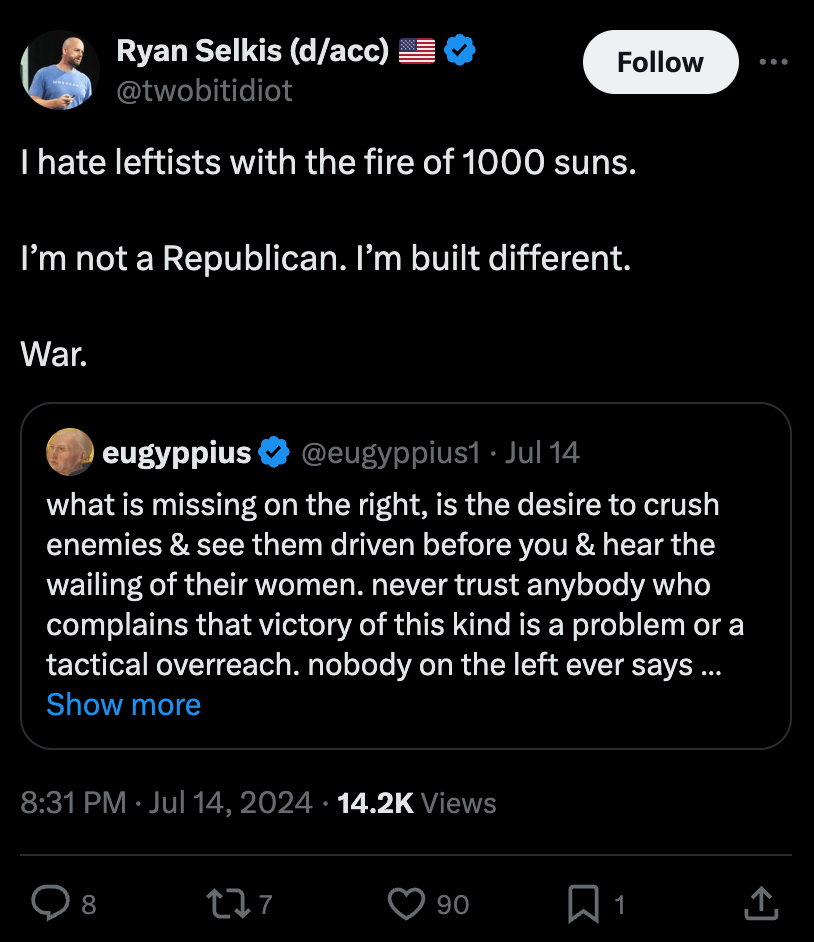
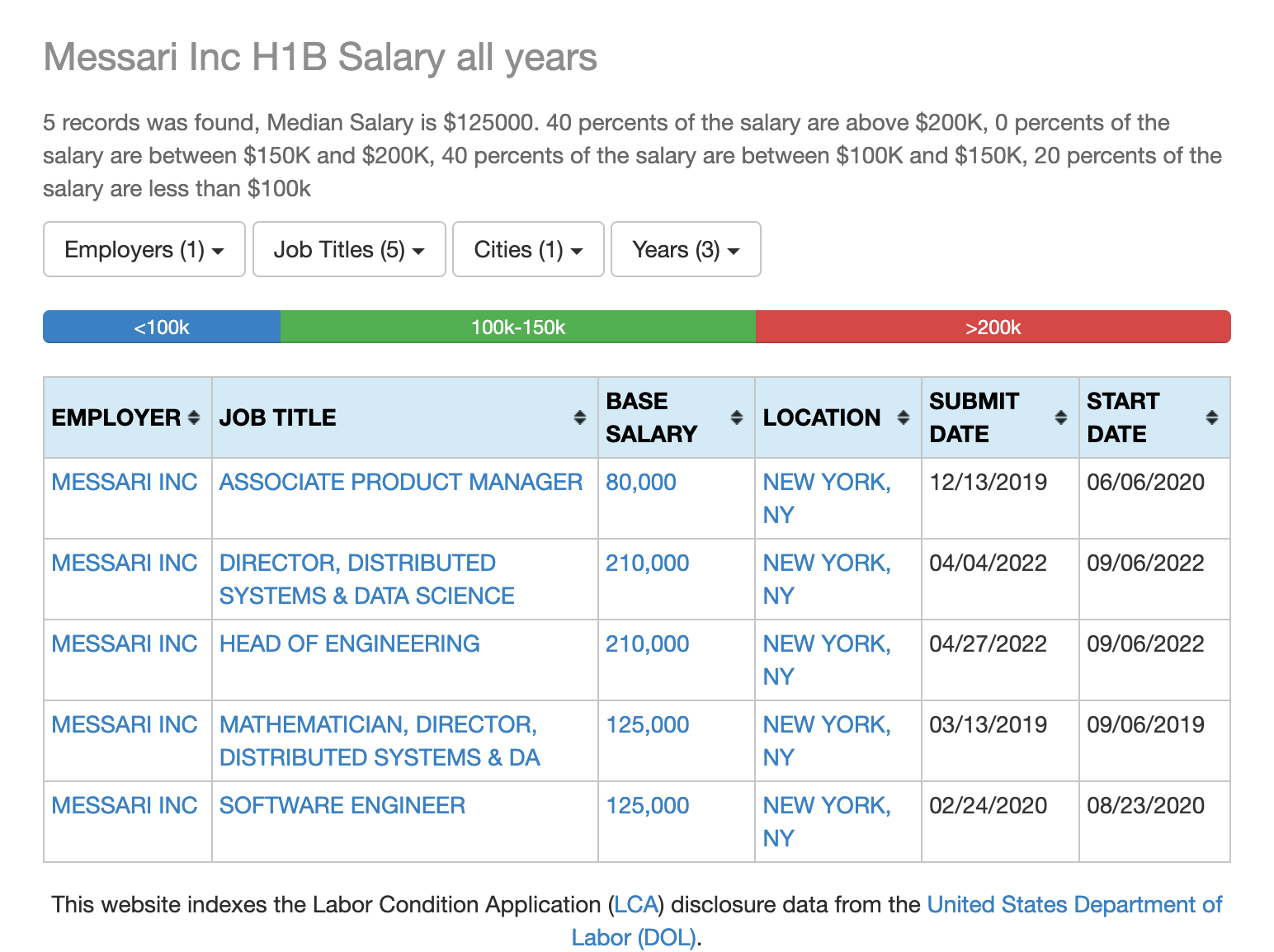
Then there was this exchange. Messari’s Head of Engineering is on an H1-B, by the way.
Some recent tweets from the founder and CEO of a prominent cryptocurrency company.
Then there was this exchange. Messari’s Head of Engineering is on an H1-B, by the way.
Follow the Crypto cited in The Guardian!
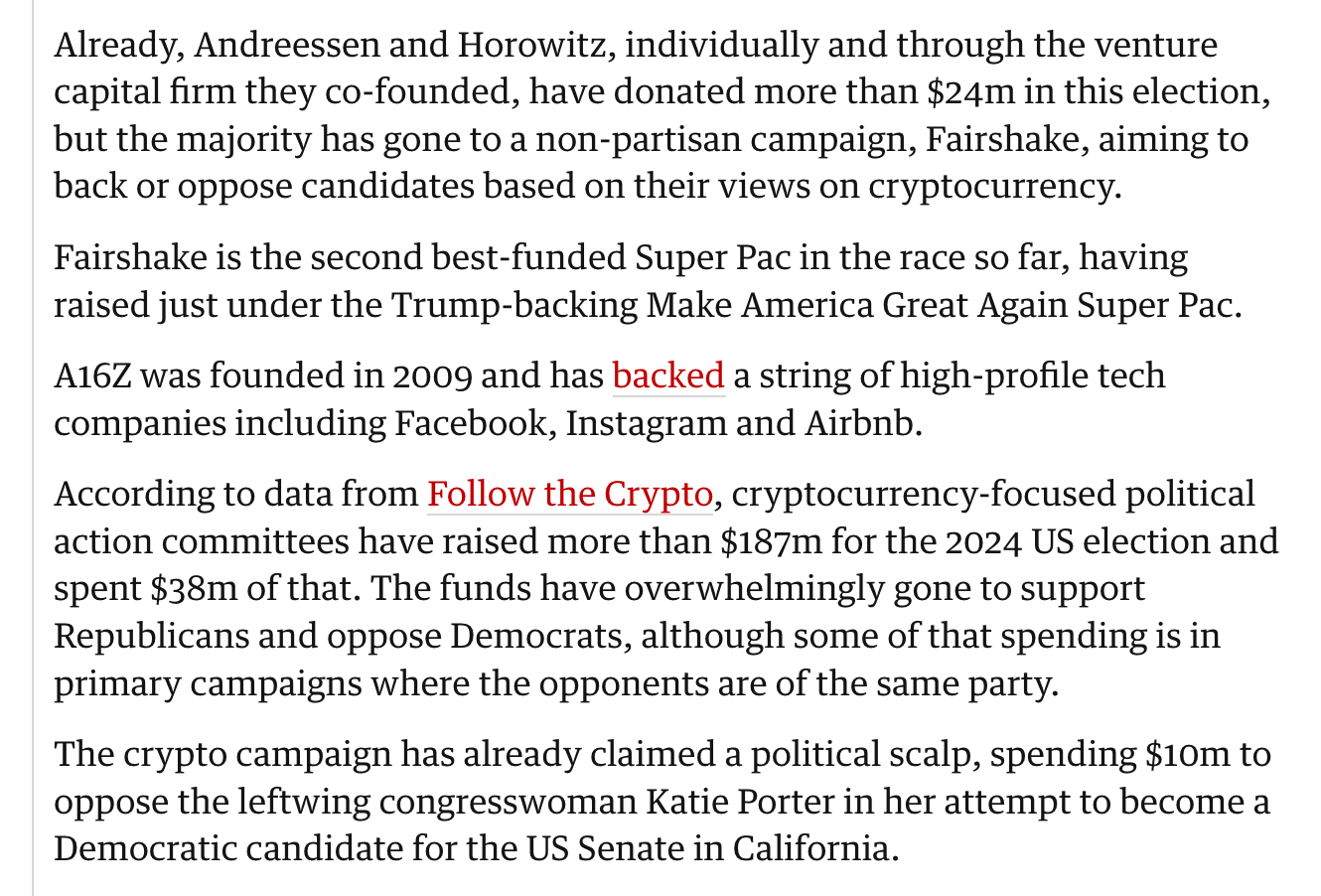
At this stage of the election cycle, cryptocurrency-focused PACs have contributed more overall to Democrats than to Republicans.
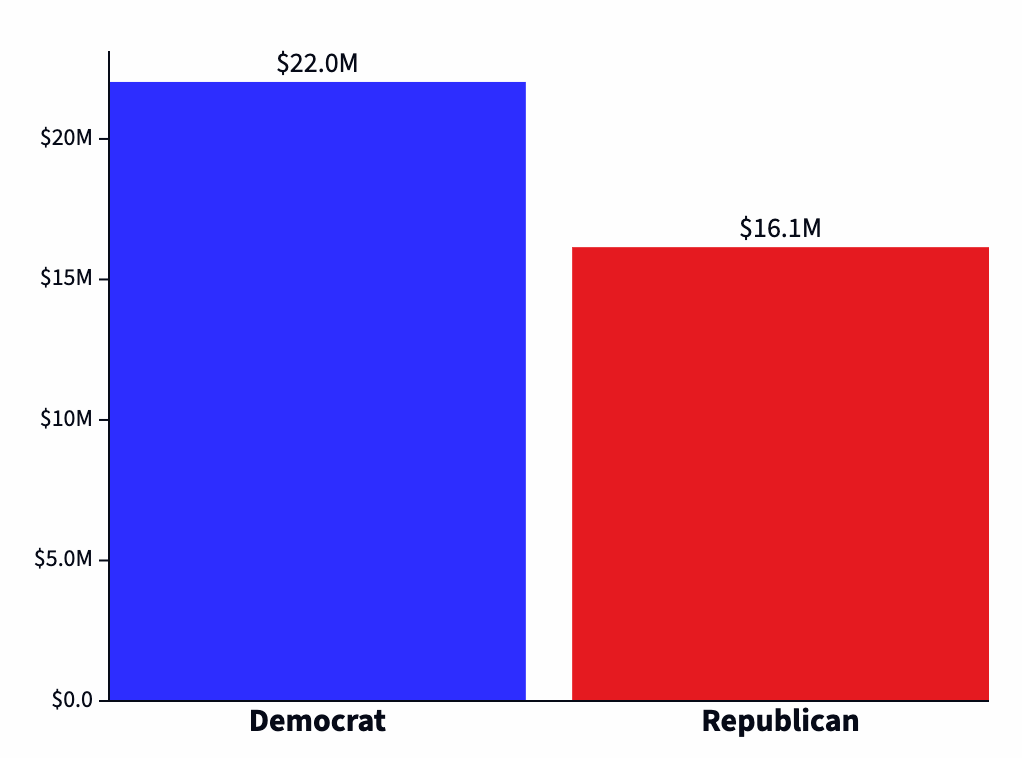
Most of this actually comes from opposition spending to Democrats. While many have assumed that crypto PACs’ opposition to Democrats was in support of Republicans, that’s not actually the case thus far. However, it's worth noting that in races where PACs have opposed candidates but have not supported any candidates (CA Senate primary, NY-16 Democratic primary), they are clearly more focused on ousting candidates they view as anti-crypto rather than on supporting any specific candidate.
Crossposting a comment I made on HackerNews about Follow the Crypto, since I'm seeing a lot of this kind of whataboutism:
The real story here is how much power individuals have over our political landscape. George Soros, for example, has injected more than $125M into the midterm race in 2022[1]. To be clear, this is not a partisan issue; the Kochs raised over $70M last year[2].I fully agree with you that the broader problem is Citizens United and the ability for corporations and the super wealthy to pour this much money into politics. In fact, I mention this here: FAQ.
I think projects like mine would be extremely valuable for all industries, and I'm enormously grateful to groups like OpenSecrets that do excellent work making a far broader swath of the data more legible. But I am one person without the research team, time, or funding that would be necessary to analyze the data this deeply across industries, and so I focus on crypto (the subject of much of my research and writing).
The code is all open source, and I would be delighted if other projects like this one sprung up. It seems it would be a bit more productive to actually shine a light all the kinds of spending that happen throughout industries and across individuals, rather than using that other spending as a sort of whataboutist argument to dismiss projects like this one that (necessarily) focus on a subset of spending.
If you want to be critical of super PACs, crypto spending is literally a drop in the bucket and completely missing the forest for the trees. There is a story here, but crypto ain't it.As this project highlights, crypto is far from a "drop in the bucket" when it comes to super PAC fundraising this cycle. The industry has dramatically ramped up its spending compared to previous election years, which is a large part of why I felt it was important to keep an eye on the spending.
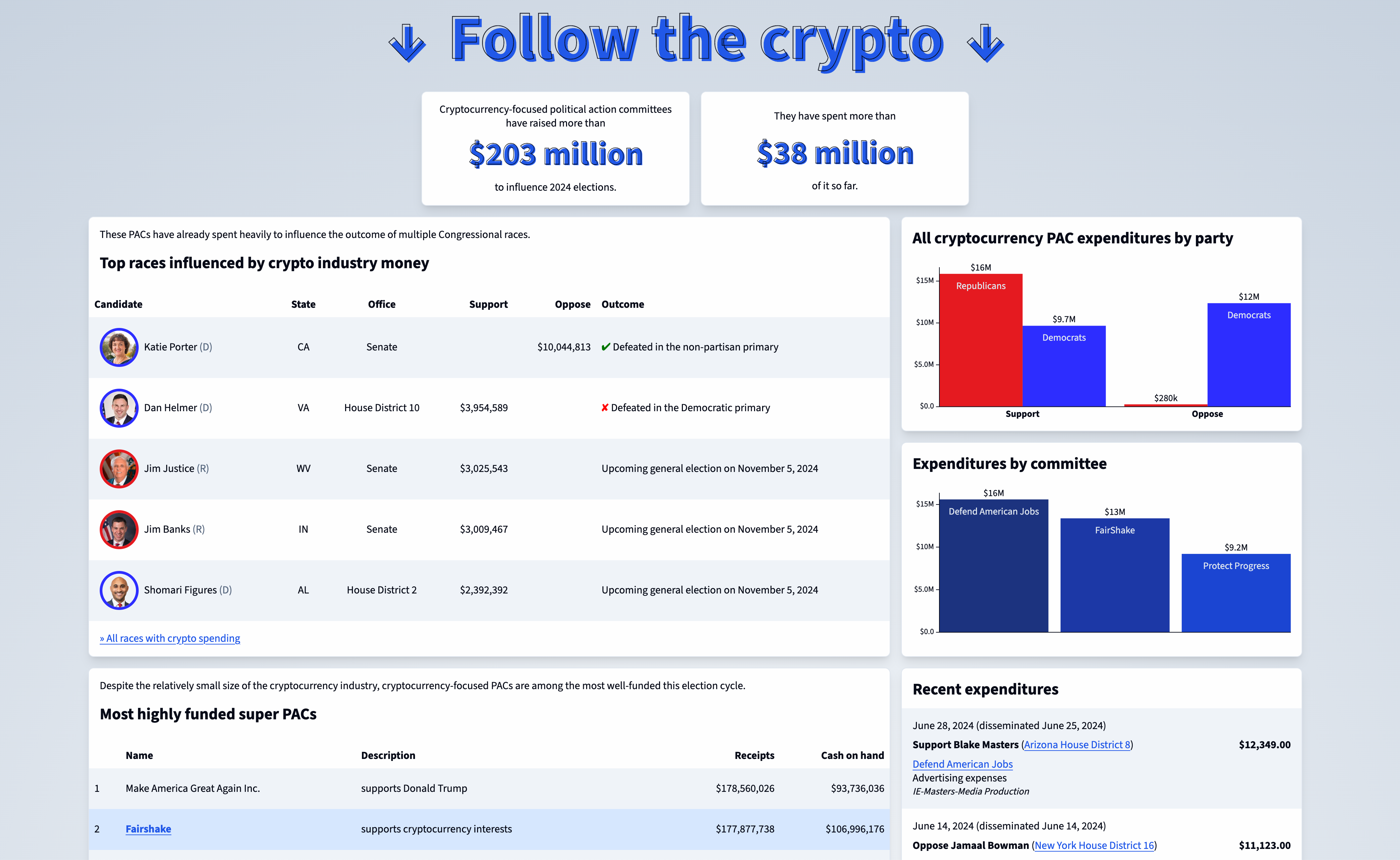
It’s finally time to release my newest project: FollowTheCrypto.org.
This website provides a real-time lens into the cryptocurrency industry’s efforts to influence 2024 elections in the United States.
Sentencing dates have been set for FTX's Nishad Singh and Gary Wang. Singh is scheduled to be sentenced on October 30, and Wang on November 20.
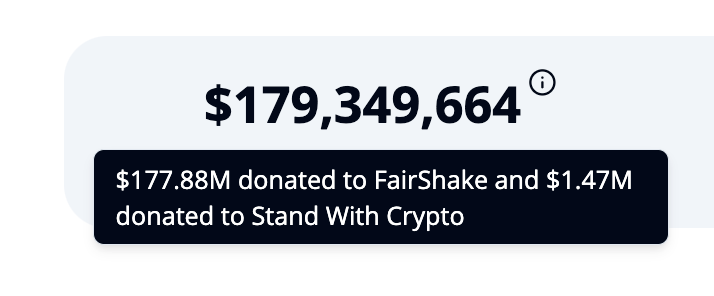
Coinbase's "Stand With Crypto" PAC website is now confirming what I reported earlier.
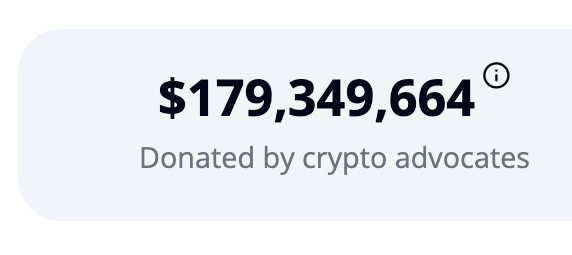
More than 99% of the amount they claimed was raised by this supposedly "grassroots" PAC is in fact massive corporate contributions to the FairShake super PAC.
Does anyone know of a good employment lawyer in California?
The two candidates in today’s primaries that received substantial backing from cryptocurrency PACs both won their primaries.
1. John Curtis defeated Trent Staggs in the Republican Utah Senate primary, with the help of $1.7 million in crypto industry funding.
One advantage to working on freely-licensed projects for over a decade is that I was forced to grapple with this decision far before mass scraping for AI training.
In my personal view, option 1 is almost strictly better. Option 2 is never as simple as "only allow actual human beings access" because determining who's a human is hard. In practice, it means putting a barrier in front of the website that makes it harder for everyone to access it: gathering personal data, CAPTCHAs, paywalls, etc.