Bluesky has released Ozone, a community moderation tool for the network. Although all Bluesky users get the default moderation out of the box, they can also subscribe to any of a number of user-created and run "labelers" (which you can see in this Bluesky list, or on this website).
Some of them label posts with content that could trigger various phobias, some label posts from Twitter, some label AI generated images, some hide spoilers, and some label... posts of beans. Others build an additional entire moderation layer on top of the defaults.
Honestly, I think it's a pretty cool approach to moderation.
Dan Luu benchmarked a bunch of different web platforms to illustrate the bloat that makes some of them completely unusable on lower-end mobile devices. His analysis was incredibly illuminating, and I thought his comments on CPU vs. bandwidth were interesting:
It's still the case that many users don't have broadband speeds, both inside and outside of the U.S. and that much of the modern web isn't usable for people with slow internet, but the exponential increase in bandwidth (Nielsen suggests this is 50% per year for high-end connections) has outpaced web bloat for typical sites, making this less of a problem than it was in 2017, although it's still a serious problem for people with poor connections. CPU performance for web apps hasn't scaled nearly as quickly as bandwidth so, while more of the web is becoming accessible to people with low-end connections, more of the web is becoming inaccessible to people with low-end devices even if they have high-end connections.
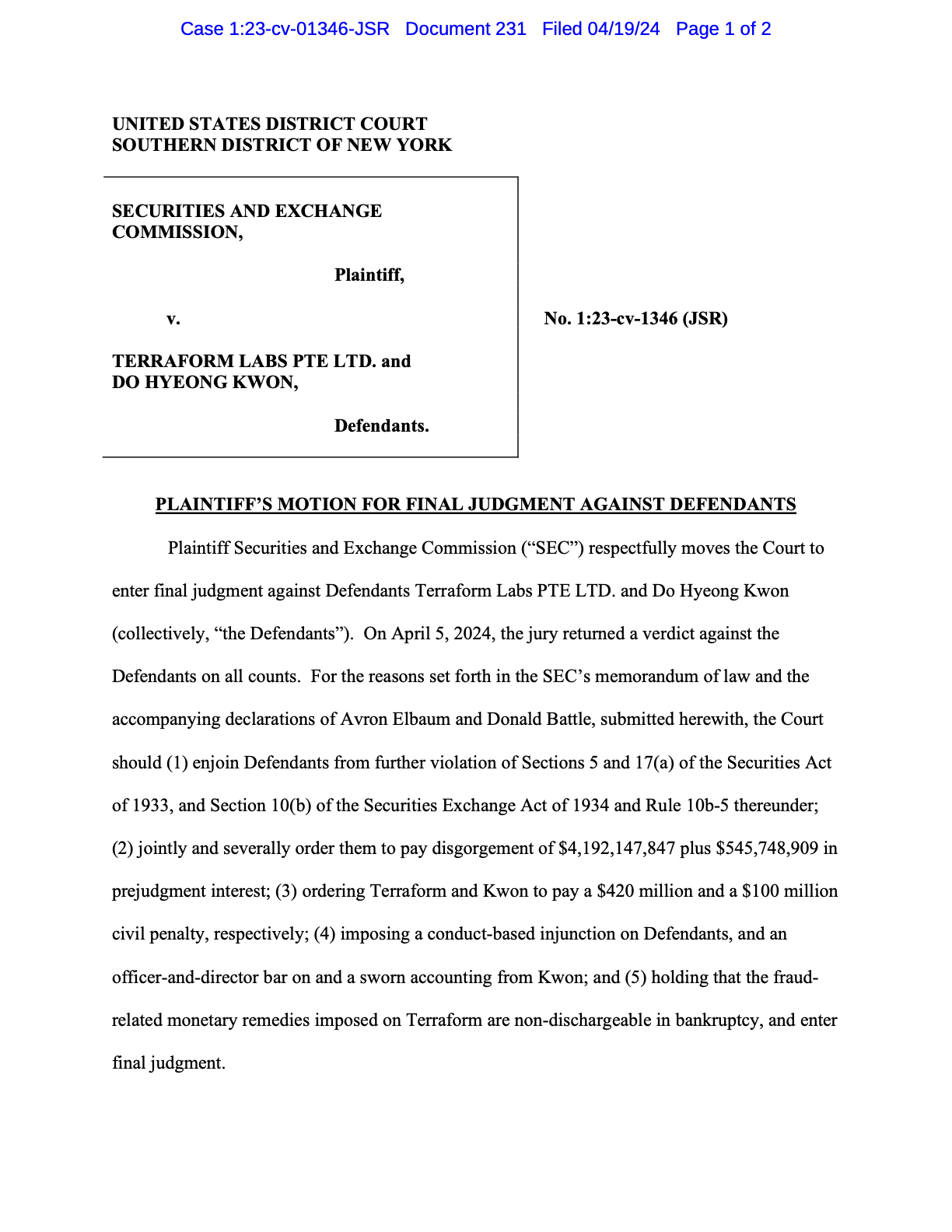
The SEC is asking the judge in the Terra lawsuit to order $4.2 billion in disgorgement, a $420 million penalty against Terraform Labs, and a $100 million penalty against Do Kwon.
They also want Kwon banned from serving as an officer or director of a publicly traded company.
Kwon has opposed any injunction or disgorgement against him, and says that the potential penalties should be somewhere around $250,000–$300,000.
it is extremely funny to me that a lot of the people who want to slash or repeal Section 230 are the same people condemning NPR's Katherine Maher for her past comments they think are "anti-First Amendment"
in those comments she is actually describing the free speech protections afforded by Section 230 (although Rufo et al have ignored where she said those protections were "very important" and instead spun her comments as though she was criticizing it)
slashing or repealing 230 is the real anti-free speech issue here; certainly not Maher's comments supporting it
A campaign against NPR's new CEO, ex-Wikimedia Foundation Katherine Maher, is trying to portray her as "anti-truth" and "anti-First Amendment" by taking quotes out of context from her past talks about Wikimedia. As a longtime Wikipedian, I think I can give a little more context about these statements — but I recognize that the people behind this campaign are, ironically, not looking for the facts.
In this video, I also go into the idea of "verifiability, not truth" — a Wikipedia philosophy that is controversial both on- and off-wiki.