Thoughts tagged "Justin Sun"

Short thoughts, notes, links, and musings by . RSS

Today the SEC filed a proposed final judgment to settle their lawsuit against Justin Sun and his businesses for $10 million and no admission of wrongdoing.

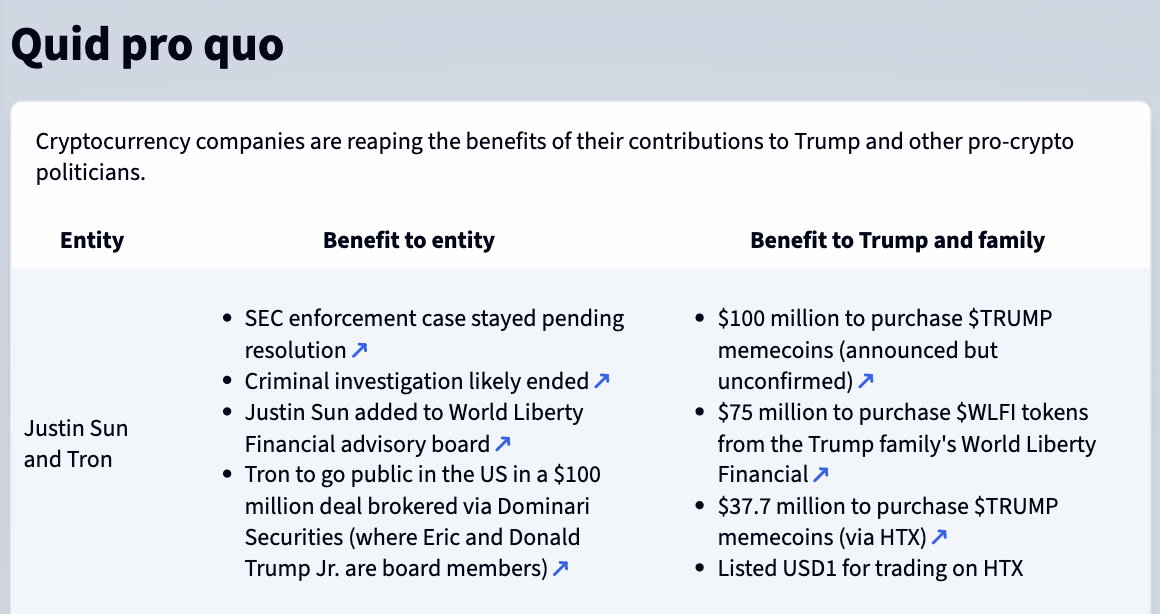
Sun has spent between $112 million and $233 million on contributions to Trump-linked crypto firms.

Entity: Justin Sun and Tron	// Benefit to entity: SEC enforcement case settled for $10 million fine with no admission of wrongdoing, Criminal investigation likely ended, Justin Sun added to World Liberty Financial advisory board, Tron to go public in the US in a $100 million deal brokered via Dominari Securities (where Eric and Donald Trump Jr. are board members) // Benefit to Trump and family: $100 million to purchase $TRUMP memecoins (announced but unconfirmed), $75 million to purchase $WLFI tokens from the Trump family's World Liberty Financial, $37.7 million to purchase $TRUMP memecoins (via HTX), $20 million to purchase shares of the Trump-linked Alt5 Sigma and more $WLFI (announced but unconfirmed), Listed USD1 for trading on HTX

In January, House Financial Services Ranking Member Maxine Waters sent a letter to SEC Chair Paul Atkins expressing concern over the SEC's "retrenchment from crypto enforcement", citing the Sun case and urging Atkins to hold him accountable.

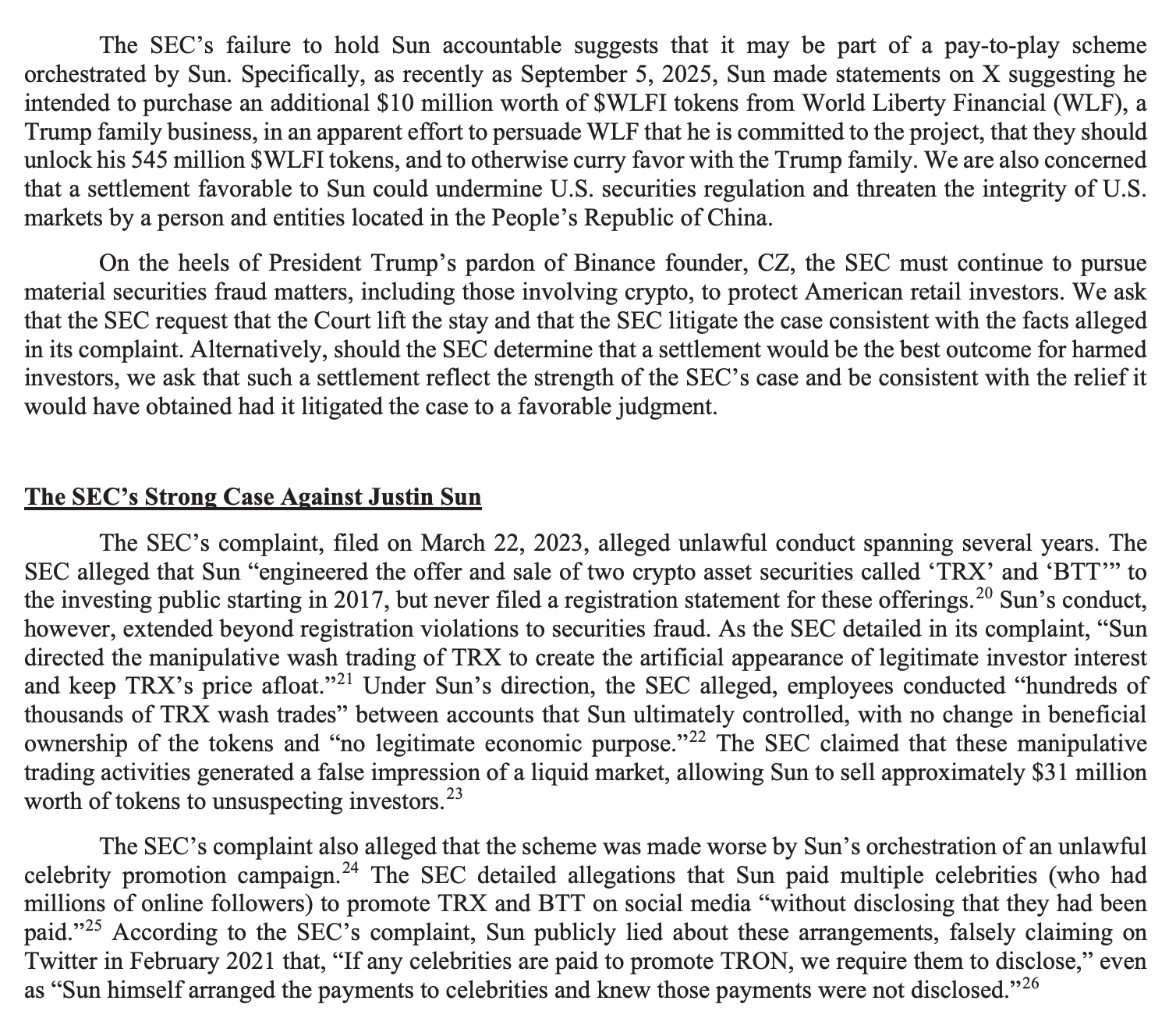
The SEC Can Still Act to Hold Justin Sun Accountable One case offers the SEC an opportunity to demonstrate to Americans that the SEC still has their back. In February 2025, as part of its efforts to shut down cases holding crypto fraudsters accountable, the SEC asked the court to stay its enforcement action against Justin Sun, founder of the Tron Foundation, SEC v. Sun, et al., Case No. 1:23-cv-02433-ER (S.D.N.Y.). Unlike the other cases detailed above, this case has not yet been dismissed. The SEC’s request to stay the Sun litigation, and subsequent efforts to settle the matter, may have been unduly influenced by Sun’s relationship with the Trump family, including his significant financial contributions to their businesses.19 So that investors harmed by Sun‘s fraudulent activities may be made whole, I ask the to SEC revisit its request to stay its litigation against Sun and renew that action. 
The SEC’s failure to hold Sun accountable suggests that it may be part of a pay-to-play scheme orchestrated by Sun. Specifically, as recently as September 5, 2025, Sun made statements on X suggesting he intended to purchase an additional $10 million worth of $WLFI tokens from World Liberty Financial (WLF), a Trump family business, in an apparent effort to persuade WLF that he is committed to the project, that they should unlock his 545 million $WLFI tokens, and to otherwise curry favor with the Trump family. We are also concerned that a settlement favorable to Sun could undermine U.S. securities regulation and threaten the integrity of U.S. markets by a person and entities located in the People’s Republic of China. On the heels of President Trump’s pardon of Binance founder, CZ, the SEC must continue to pursue material securities fraud matters, including those involving crypto, to protect American retail investors. We ask that the SEC request that the Court lift the stay and that the SEC litigate the case consistent with the facts alleged in its complaint. Alternatively, should the SEC determine that a settlement would be the best outcome for harmed investors, we ask that such a settlement reflect the strength of the SEC’s case and be consistent with the relief it would have obtained had it litigated the case to a favorable judgment. The SEC’s Strong Case Against Justin Sun The SEC’s complaint, filed on March 22, 2023, alleged unlawful conduct spanning several years. The SEC alleged that Sun “engineered the offer and sale of two crypto asset securities called ‘TRX’ and ‘BTT’” to the investing public starting in 2017, but never filed a registration statement for these offerings.20 Sun’s conduct, however, extended beyond registration violations to securities fraud. As the SEC detailed in its complaint, “Sun directed the manipulative wash trading of TRX to create the artificial appearance of legitimate investor interest and keep TRX’s price afloat.”21 Under Sun’s direction, the SEC alleged, employees conducted “hundreds of thousands of TRX wash trades” between accounts that Sun ultimately controlled, with no change in beneficial ownership of the tokens and “no legitimate economic purpose.”22 The SEC claimed that these manipulative trading activities generated a false impression of a liquid market, allowing Sun to sell approximately $31 million worth of tokens to unsuspecting investors.23 The SEC’s complaint also alleged that the scheme was made worse by Sun’s orchestration of an unlawful celebrity promotion campaign.24 The SEC detailed allegations that Sun paid multiple celebrities (who had millions of online followers) to promote TRX and BTT on social media “without disclosing that they had been paid.”25 According to the SEC’s complaint, Sun publicly lied about these arrangements, falsely claiming on Twitter in February 2021 that, “If any celebrities are paid to promote TRON, we require them to disclose,” even as “Sun himself arranged the payments to celebrities and knew those payments were not disclosed.”26 

Chair Atkins has suggested that the crypto cases his agency has dropped were merely over "registration issues" that were "red herrings" from the Biden admin. But the complaint against Sun also alleged serious fraud.

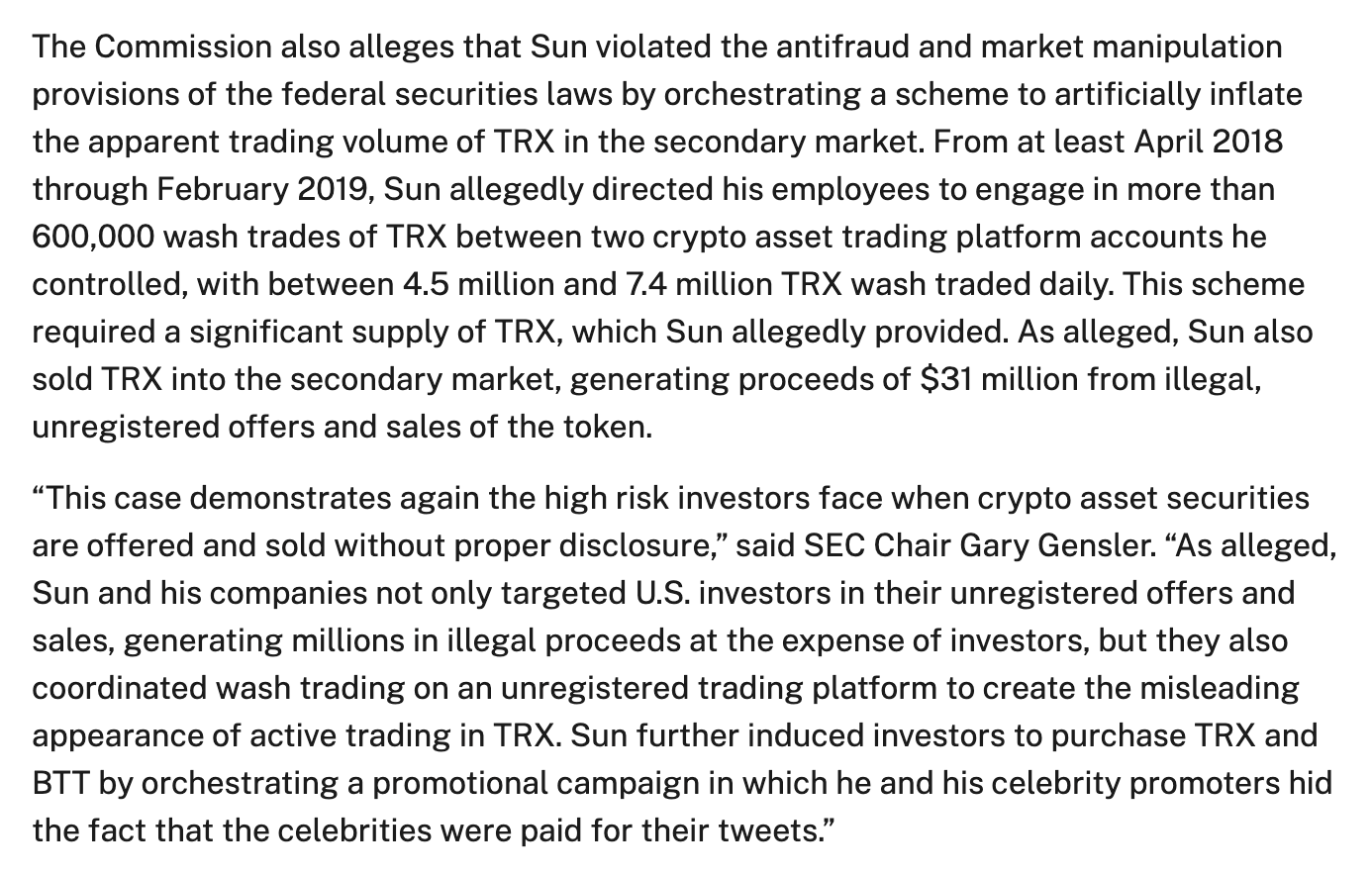
The Commission also alleges that Sun violated the antifraud and market manipulation provisions of the federal securities laws by orchestrating a scheme to artificially inflate the apparent trading volume of TRX in the secondary market. From at least April 2018 through February 2019, Sun allegedly directed his employees to engage in more than 600,000 wash trades of TRX between two crypto asset trading platform accounts he controlled, with between 4.5 million and 7.4 million TRX wash traded daily. This scheme required a significant supply of TRX, which Sun allegedly provided. As alleged, Sun also sold TRX into the secondary market, generating proceeds of $31 million from illegal, unregistered offers and sales of the token.  “This case demonstrates again the high risk investors face when crypto asset securities are offered and sold without proper disclosure,” said SEC Chair Gary Gensler. “As alleged, Sun and his companies not only targeted U.S. investors in their unregistered offers and sales, generating millions in illegal proceeds at the expense of investors, but they also coordinated wash trading on an unregistered trading platform to create the misleading appearance of active trading in TRX. Sun further induced investors to purchase TRX and BTT by orchestrating a promotional campaign in which he and his celebrity promoters hid the fact that the celebrities were paid for their tweets.”

In July, shortly after Sun announced his plan to purchase another $100 million of the $TRUMP memecoin, the Sun-involved and -themed SUNDOG memecoin posted a meme showing its corgi mascot holding puppet strings attached to the White House.

Tweet screenshot: SunDog @SUNDOG_TRX You never truly know who’s pulling the strings… 🤫 [AI-generated image of a corgi dog with a collar depicting the Tron logo, paws raised above the White House, with strings attached to the paws like a marionette] 2:30 AM Jul 24, 2025

Bloomberg has filed their opposition to Justin Sun’s renewed motion for emergency relief, arguing they never promised not to publish the information he and his team provided to them. They also argue that his demands they remove the article about him and prevent them from publishing a second one would violate the First Amendment.

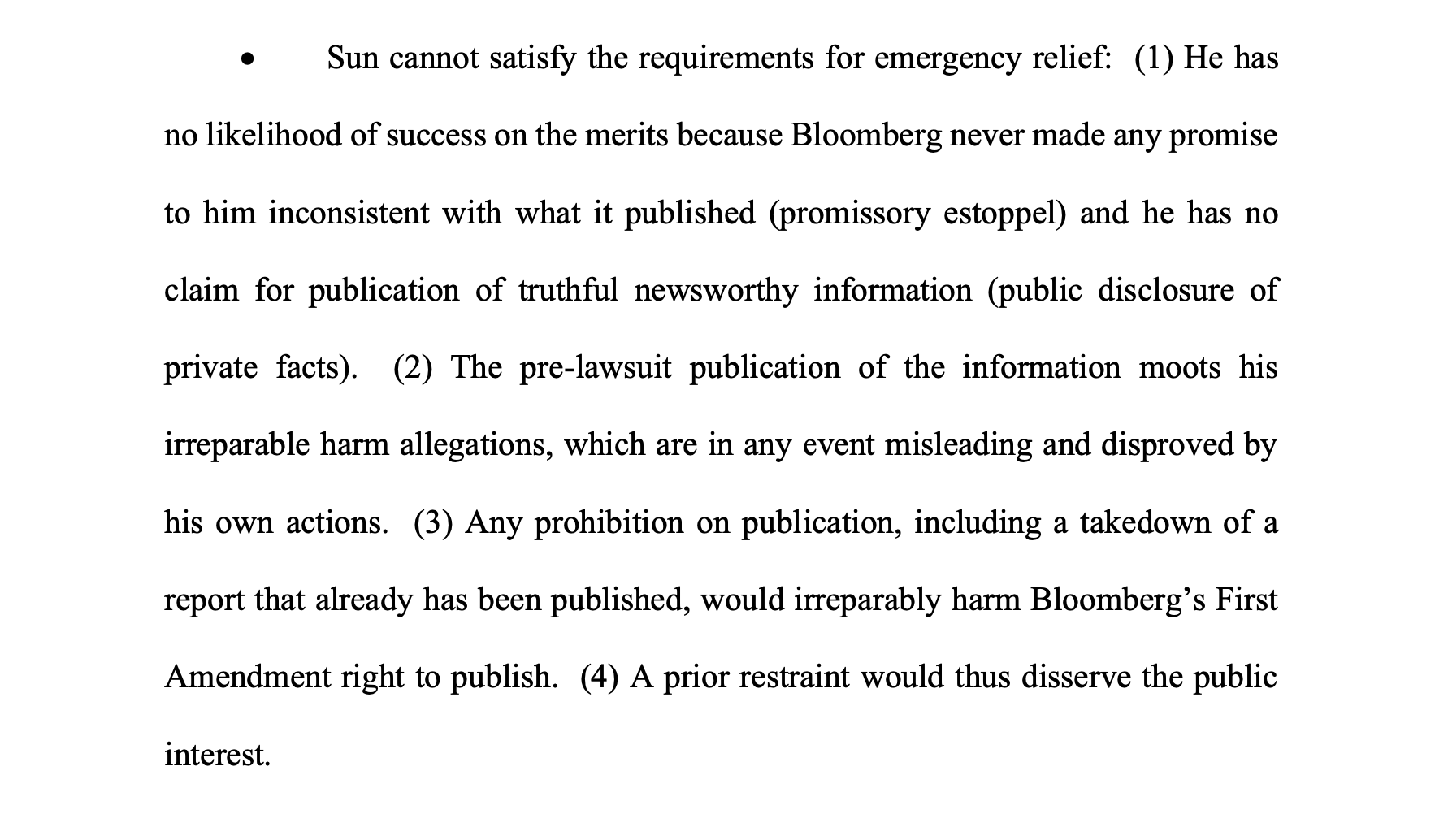
Sun cannot satisfy the requirements for emergency relief: (1) He has no likelihood of success on the merits because Bloomberg never made any promise to him inconsistent with what it published (promissory estoppel) and he has no claim for publication of truthful newsworthy information (public disclosure of private facts). (2) The pre-lawsuit publication of the information moots his irreparable harm allegations, which are in any event misleading and disproved by his own actions. (3) Any prohibition on publication, including a takedown of a report that already has been published, would irreparably harm Bloomberg’s First Amendment right to publish. (4) A prior restraint would thus disserve the public interest.

(Answering brief)

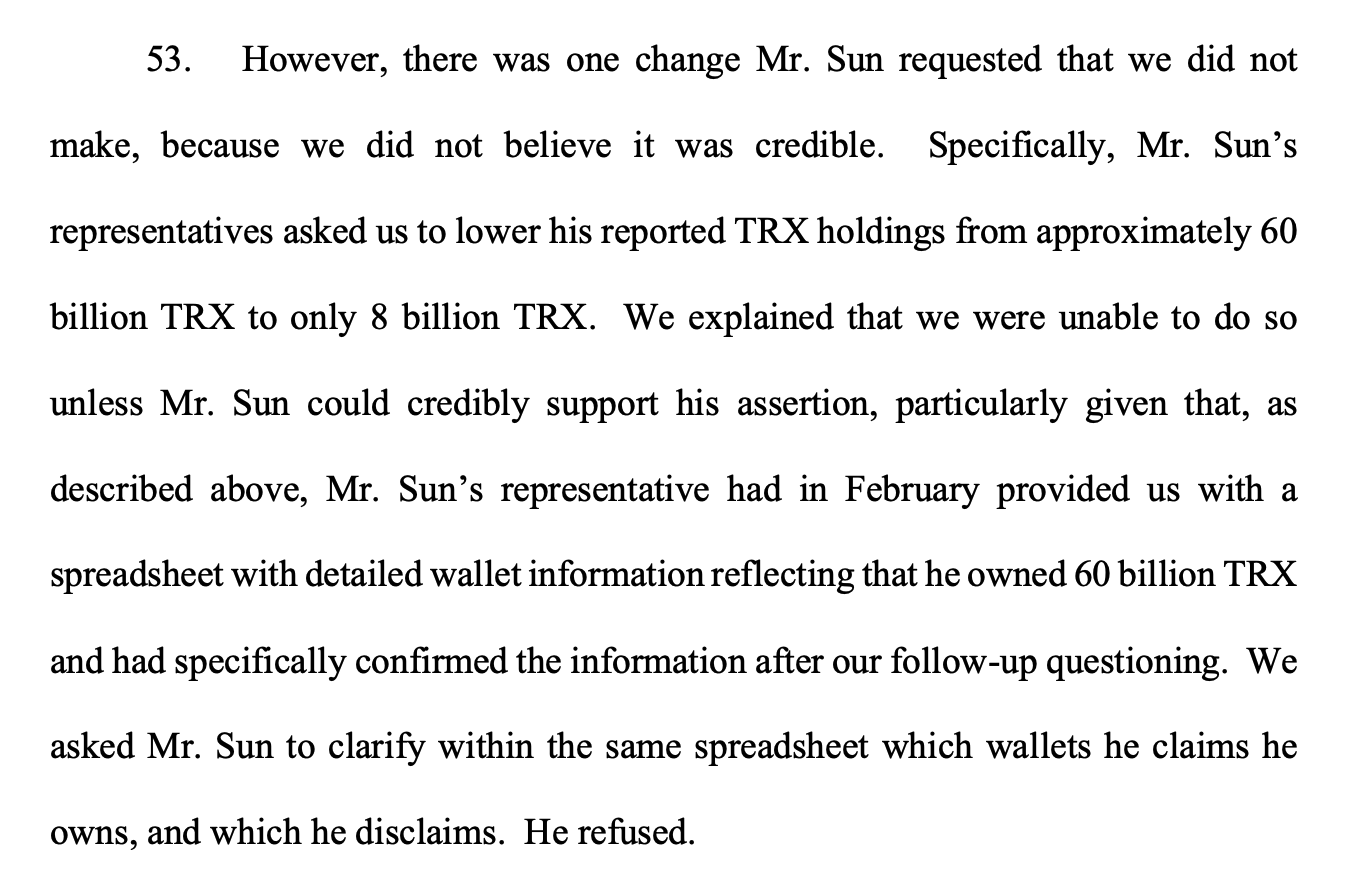
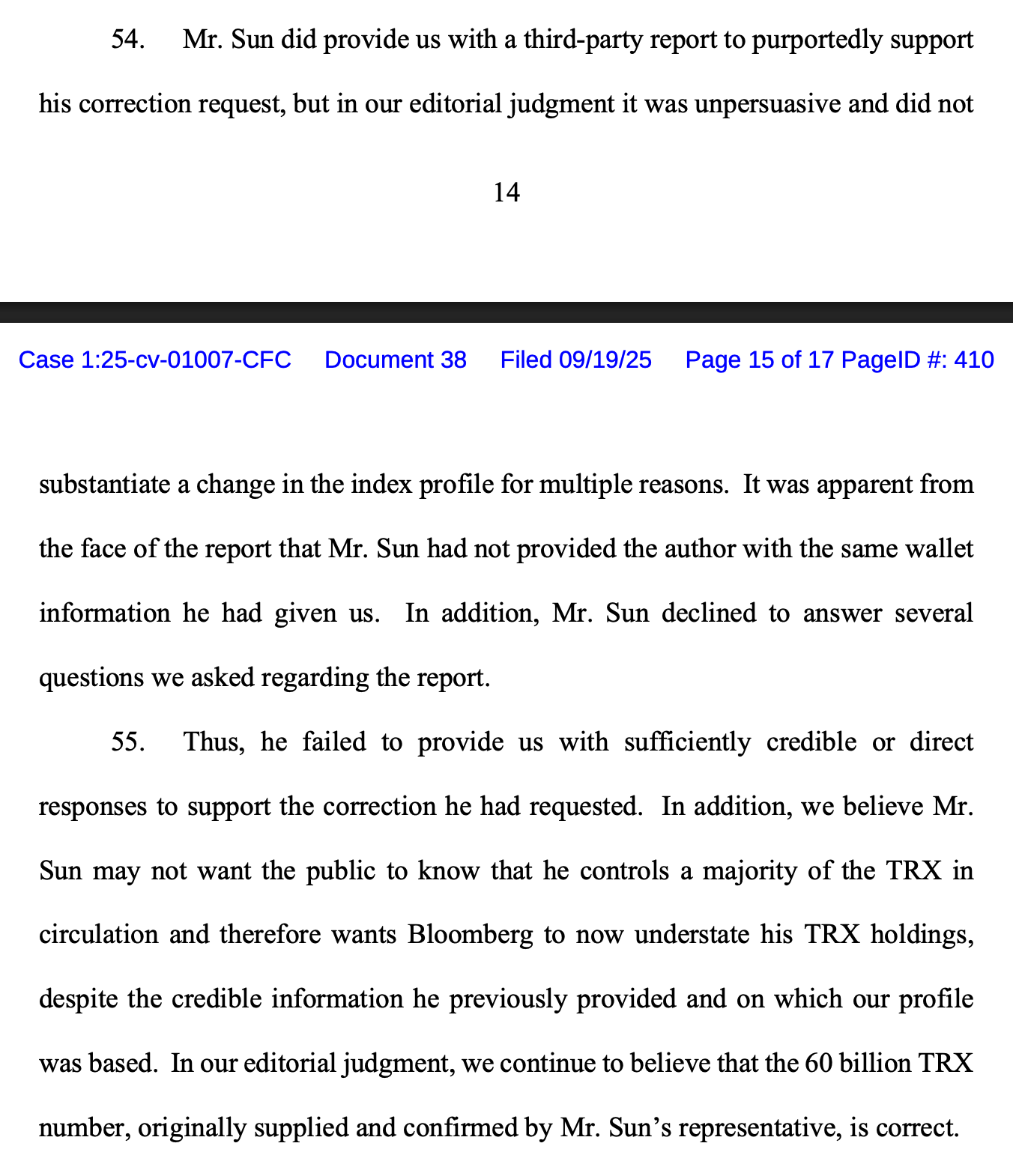
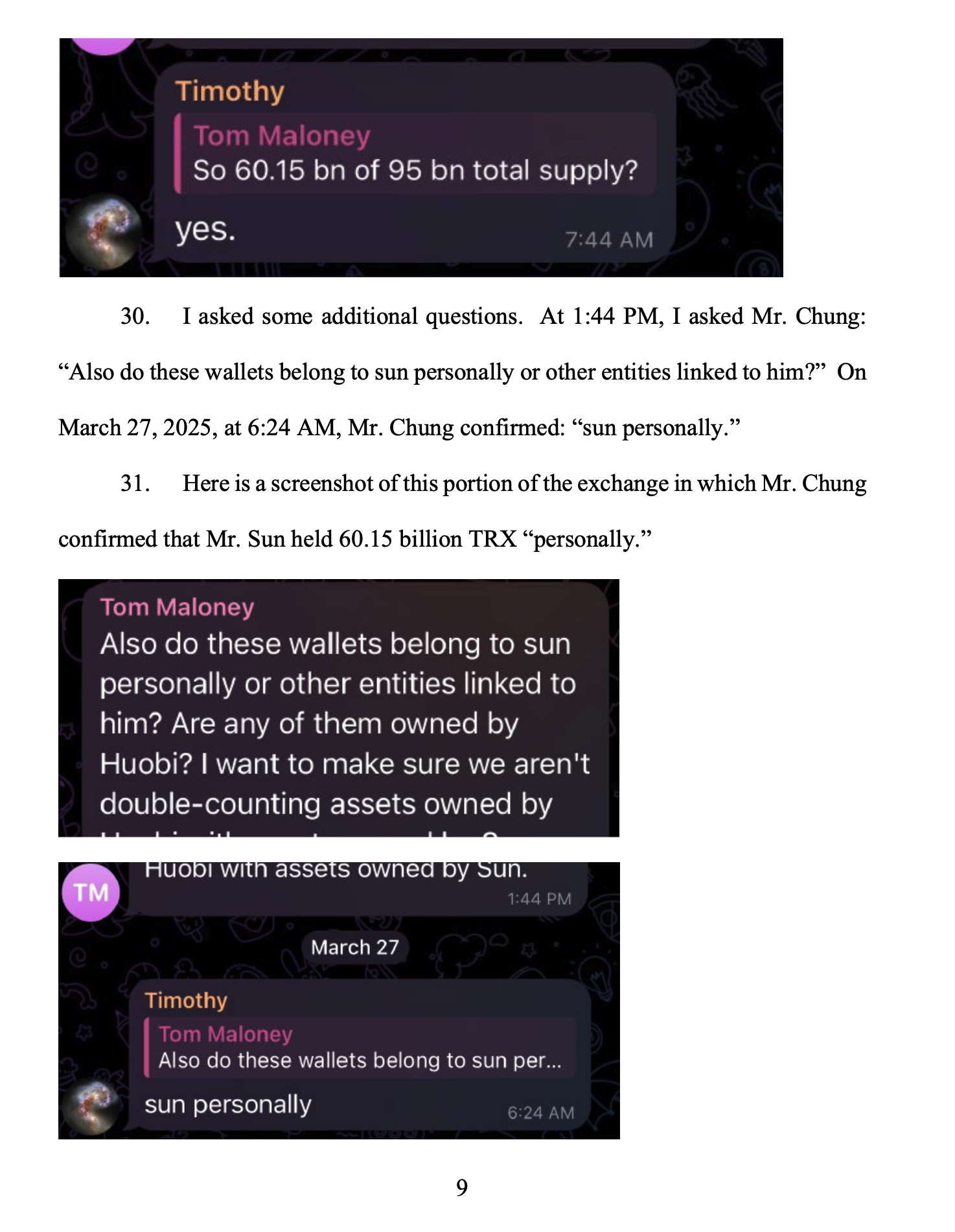
After publication, Sun asked Bloomberg to reduce his supposed ownership of TRX from 60 billion (~63% of circulating supply) to only 8 billion. Bloomberg refused. “[W]e believe Mr. Sun may not want the public to know that he controls a majority of the TRX in circulation”

(Maloney declaration)

Also: I seem to have become an exhibit

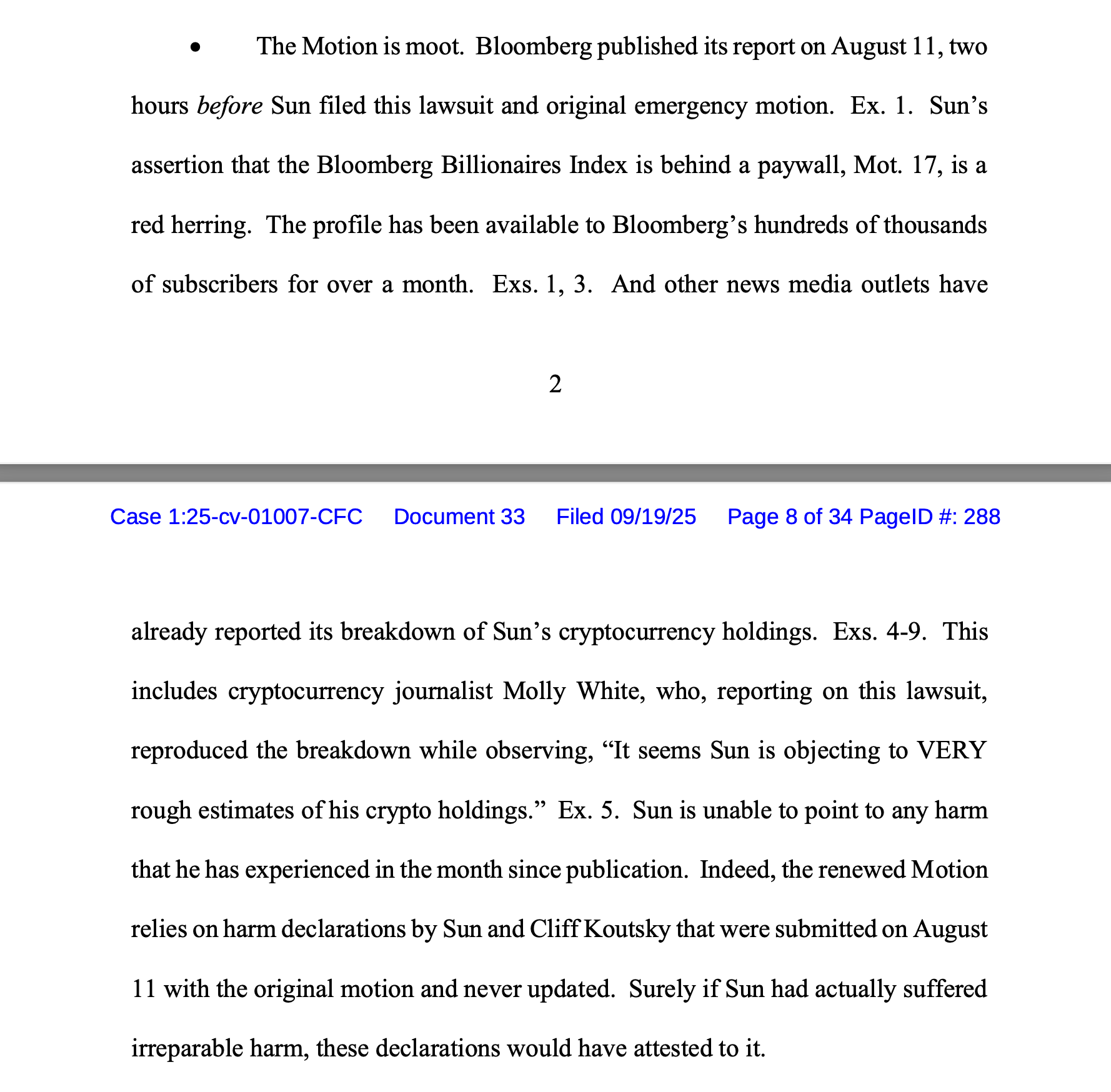
(Answering brief, exhibit 5 to Hentoff declaration)

Bloomberg has responded to Justin Sun’s renewed motion for a temporary restraining order.

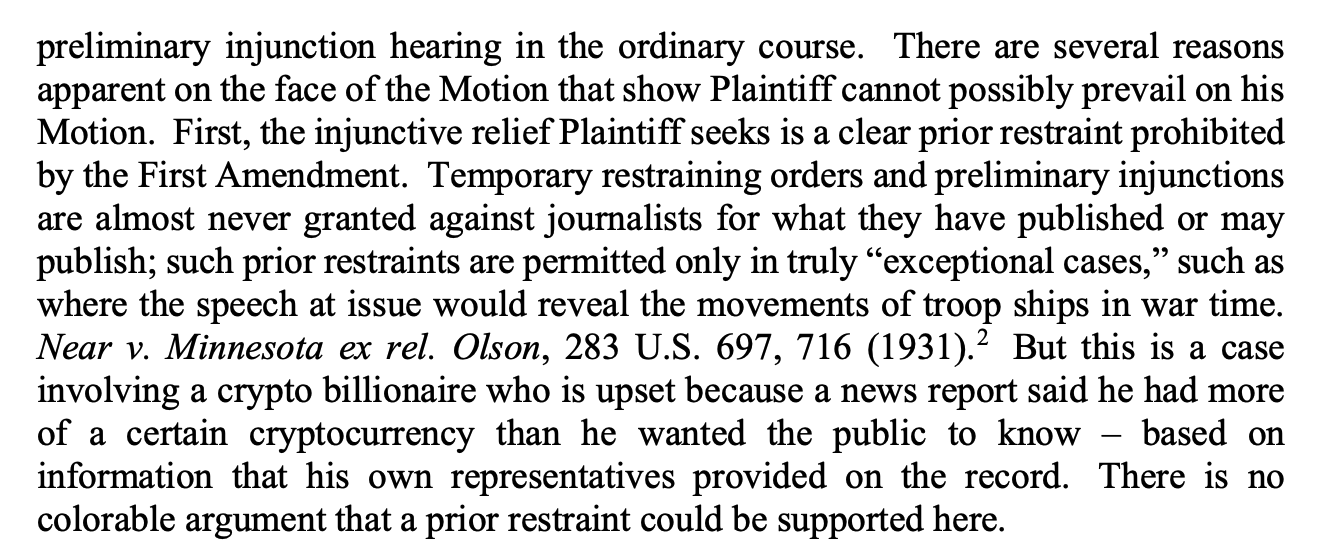
“This is a case involving a crypto billionaire who is upset because a news report said he had more of a certain cryptocurrency than he wanted the public to know — based on information that his own representatives provided on the record.”

preliminary injunction hearing in the ordinary course. There are several reasons apparent on the face of the Motion that show Plaintiff cannot possibly prevail on his Motion. First, the injunctive relief Plaintiff seeks is a clear prior restraint prohibited by the First Amendment. Temporary restraining orders and preliminary injunctions are almost never granted against journalists for what they have published or may publish; such prior restraints are permitted only in truly “exceptional cases,” such as where the speech at issue would reveal the movements of troop ships in war time. Near v. Minnesota ex rel. Olson, 283 U.S. 697, 716 (1931).2 But this is a case involving a crypto billionaire who is upset because a news report said he had more of a certain cryptocurrency than he wanted the public to know – based on information that his own representatives provided on the record. There is no colorable argument that a prior restraint could be supported here. 

Letter

Crypto billionaire Justin Sun’s renewed motion for a temporary restraining order in his lawsuit against Bloomberg seems to confirm my view that the lawsuit was sparked by the disclosure that he controls 63% of the supply of TRX.

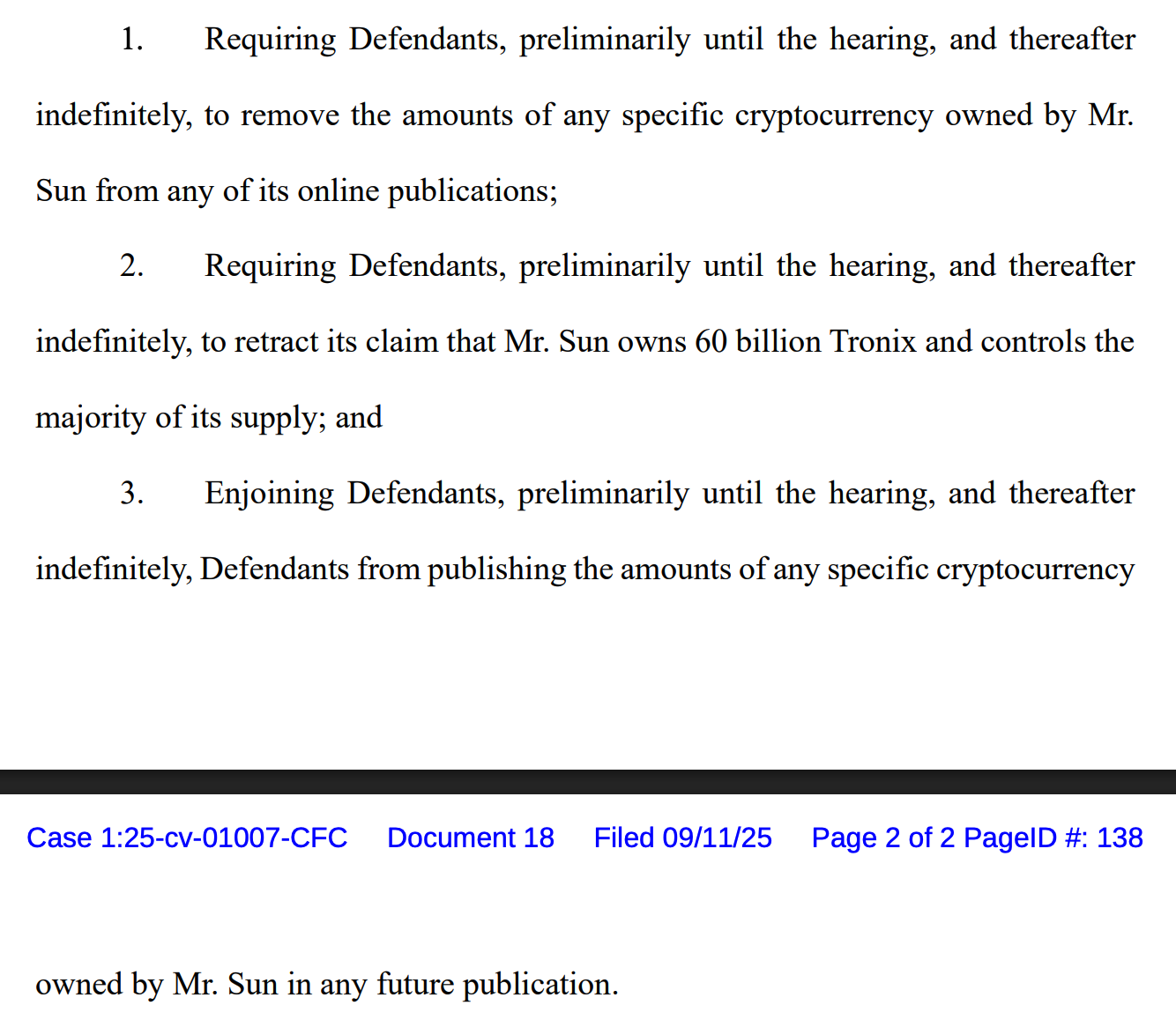
1. Requiring Defendants, preliminarily until the hearing, and thereafter indefinitely, to remove the amounts of any specific cryptocurrency owned by Mr. Sun from any of its online publications; 2. Requiring Defendants, preliminarily until the hearing, and thereafter indefinitely, to retract its claim that Mr. Sun owns 60 billion Tronix and controls the majority of its supply; and 3. Enjoining Defendants, preliminarily until the hearing, and thereafter indefinitely, Defendants from publishing the amounts of any specific cryptocurrency owned by Mr. Sun in any future publication.

Sun and Bloomberg had been “engaged in discussions that may moot the emergency relief”, but it sounds like Sun wanted more than they were willing to agree to.

The Trumps' World Liberty Financial project has frozen WLFI tokens in wallet addresses belonging to Justin Sun that contain ~$100 million (on paper) in unlocked WLFI. Sun is a major backer of the project, which the Trumps say they founded to stop "debanking".

The freeze apparently came after Sun transferred around ~$9M of his holdings to Binance.

The World Liberty team has been desperately trying to prevent the WLFI price from sinking, including by burning tokens to boost the price. They may be concerned that whales like Sun could further depress the token price by cashing out.

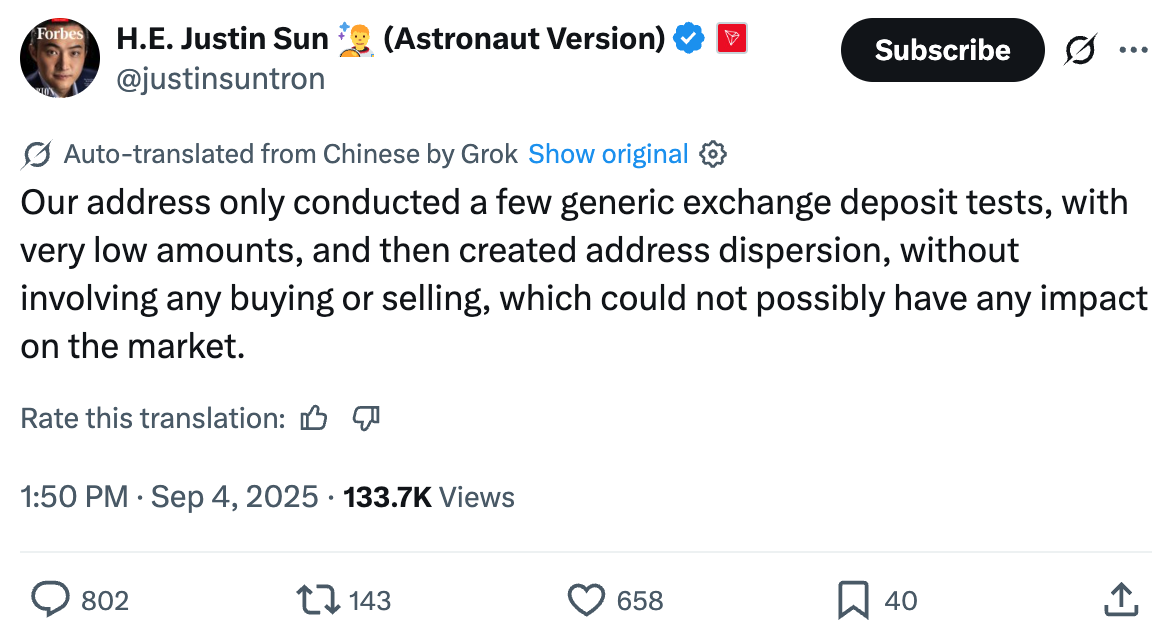
Sun is claiming he was merely testing exchange deposits (?) and not buying or selling. He seems to be responding to suggestions that he was the one tanking the token price, though it's not clear if this blame is coming from WLF directly.

Tweet by Justin Sun: Our address only conducted a few generic exchange deposit tests, with very low amounts, and then created address dispersion, without involving any buying or selling, which could not possibly have any impact on the market.

(Autotranslated from Chinese by Twitter)

Prior to this, Justin Sun's HTX exchange was running a "high-yield event", offering people 20% APY if they deposited their WLFI tokens on his exchange.

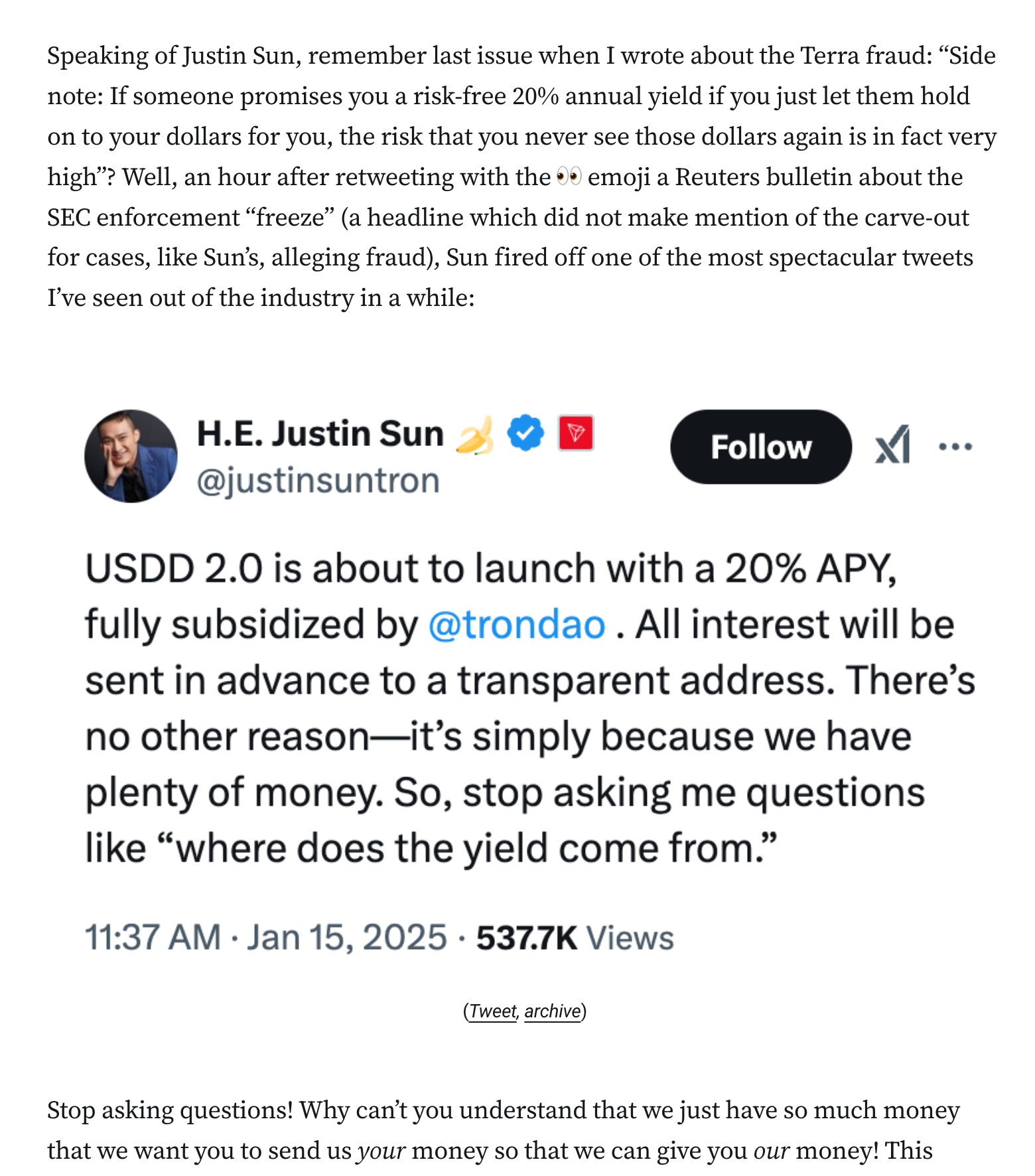
Sun has in the past snapped at people questioning his high-yield products, admonishing them to "stop asking me questions like 'where does the yield come from'" and claiming it's fully subsidized by the company. As I wrote then:

Speaking of Justin Sun, remember last issue when I wrote about the Terra fraud: “Side note: If someone promises you a risk-free 20% annual yield if you just let them hold on to your dollars for you, the risk that you never see those dollars again is in fact very high”? Well, an hour after retweeting with the 👀 emoji a Reuters bulletin about the SEC enforcement “freeze” (a headline which did not make mention of the carve-out for cases, like Sun’s, alleging fraud), Sun fired off one of the most spectacular tweets I’ve seen out of the industry in a while:

H.E. Justin Sun @justinsuntron  USDD 2.0 is about to launch with a 20% APY, fully subsidized by @trondao. All interest will be sent in advance to a transparent address. There’s no other reason—it’s simply because we have plenty of money. So, stop asking me questions like “where does the yield come from.”
(Tweet, archive)
Stop asking questions! Why can’t you understand that we just have so much money that we want you to send us your money so that we can give you our money!

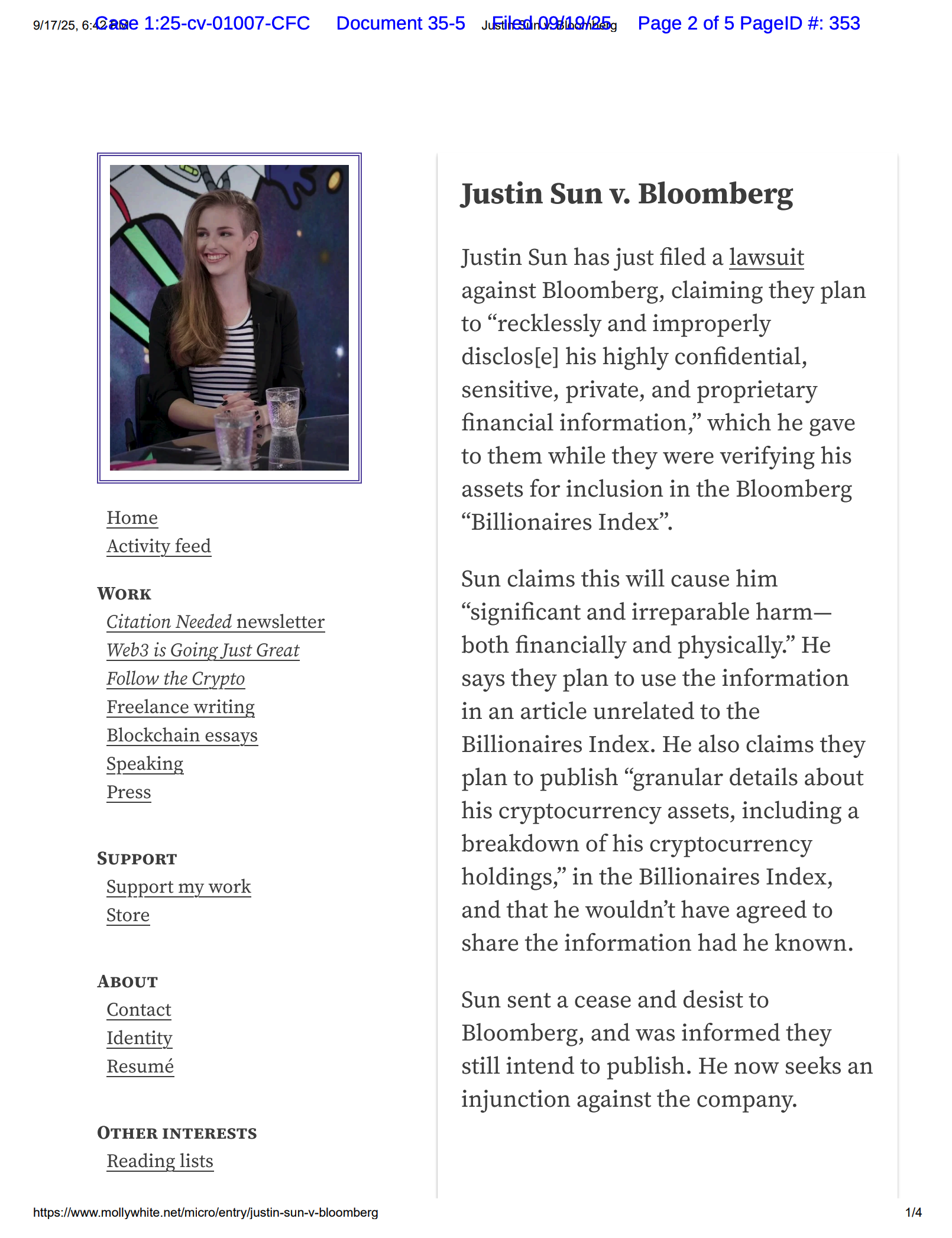
Justin Sun v. Bloomberg

Justin Sun has just filed a lawsuit against Bloomberg, claiming they plan to “recklessly and improperly disclos[e] his highly confidential, sensitive, private, and proprietary financial information,” which he gave to them while they were verifying his assets for inclusion in the Bloomberg “Billionaires Index”.

Sun claims this will cause him “significant and irreparable harm—both financially and physically.” He says they plan to use the information in an article unrelated to the Billionaires Index. He also claims they plan to publish “granular details about his cryptocurrency assets, including a breakdown of his cryptocurrency holdings,” in the Billionaires Index, and that he wouldn’t have agreed to share the information had he known.

Sun sent a cease and desist to Bloomberg, and was informed they still intend to publish. He now seeks an injunction against the company.

The “agreement” Justin Sun says should prevent Bloomberg from publishing the amounts and types of crypto assets he holds seems extremely shaky to me (caveat: I’m not a lawyer, some images are missing).

It looks like Justin Sun and his team sent the information he now claims is confidential on or around February 28.

A month later, on March 27, Justin Sun posted terms including: “The data is solely for verification and may not be used for any other purpose (including reporting) ... Bloomberg must also agree to use the data strictly in accordance with our requirements — for example, to provide only a general assessment or overall valuation based on the data, without making any specific references or detailed reporting on the figures.”

Bloomberg’s Tom Maloney: “Nobody at Bloomberg agreed to the terms sent by Justin, weeks after the data was shared with us.”

Bloomberg says they will oppose a temporary restraining order, but also that a TRO is moot because Bloomberg already published.

It seems Sun is objecting to VERY rough estimates of his crypto holdings (~60 billion TRX, heavily discounted; 17k BTC; 224K ETH; 700K Tether).

Confidence rating: 1 star
The majority of Sun's net worth comes from cryptocurrency he owns.
Sun owns more than 60 billion Tronix (also referred to as TRON or TRX), the cryptocurrency native to Tron, according to an analysis of financial information provided by representatives of Sun in February 2025. A 75% liquidity discount is applied to the value of the token because Sun controls the majority of its supply. Tron has more than 300 million user accounts as of June 2025, according to the Tronscan website.
Sun also owns about 17,000 Bitcoin, 224,000 Ether, and 700,000 Tether, according to the same analysis. No discount is applied to these because his holdings represent less than 1% of the total supply.
The analysis only includes tokens that are on-chain. Tokens that are held on exchanges such as HTX and Binance are not included in the analysis because the holdings could not be verified.
Sun owns the cryptocurrency exchange HTX. It's calculated to have had revenue of about $1.3 billion in 2024, based on its spot and derivative trading volumes and fee schedules. It's valued using the average price-to-sales multiple of Coinbase Global Inc., Galaxy Digital Inc. and Riot Platforms Inc. Sun is credited with about 90% of the company, based on information provided by his representatives in May 2025. A 50% liquidity discount is applied.
Confidence rating: 1 star
The majority of Sun's net worth comes from cryptocurrency he owns.
Sun owns more than 60 billion Tronix (also referred to as TRON or TRX), the cryptocurrency native to Tron, according to an analysis of financial information provided by representatives of Sun in February 2025. A 75% liquidity discount is applied to the value of the token because Sun controls the majority of its supply. Tron has more than 300 million user accounts as of June 2025, according to the Tronscan website.
Sun also owns about 17,000 Bitcoin, 224,000 Ether, and 700,000 Tether, according to the same analysis. No discount is applied to these because his holdings represent less than 1% of the total supply.
The analysis only includes tokens that are on-chain. Tokens that are held on exchanges such as HTX and Binance are not included in the analysis because the holdings could not be verified.
Sun owns the cryptocurrency exchange HTX. It's calculated to have had revenue of about $1.3 billion in 2024, based on its spot and derivative trading volumes and fee schedules. It's valued using the average price-to-sales multiple of Coinbase Global Inc., Galaxy Digital Inc. and Riot Platforms Inc. Sun is credited with about 90% of the company, based on information provided by his representatives in May 2025. A 50% liquidity discount is applied.

My guess is that his fury here is at the revelation that he controls 60 billion TRX (63% of the total supply, and it’s not clear to what extent they’re counting TRX held by companies he owns). It’s always been known he owns a lot, but estimates I’ve seen are lower than that.

The other explanations that I’ve brainstormed don’t really make sense. The estimates likely aren’t specific enough to be identifying, as he claims. And I doubt it’s an ego thing at having his net worth shown to be lower than he wants — Bloomberg puts him at $12.4B, higher than Forbes’ $8.5B. (Though maybe he wants them to say his 60B TRX are worth $21.6B, idk)