BlueSky’s “user intents” is a good proposal, and it’s weird to see some people flaming them for it as though this is equivalent to them welcoming in AI scraping (rather than trying to add a consent signal to allow users to communicate preferences for the scraping that is already happening).
I think the weakness with this and Creative Commons’ similar proposal for “preference signals” is that they rely on scrapers to respect these signals out of some desire to be good actors. We’ve already seen some of these companies blow right past robots.txt or pirate material to scrape.

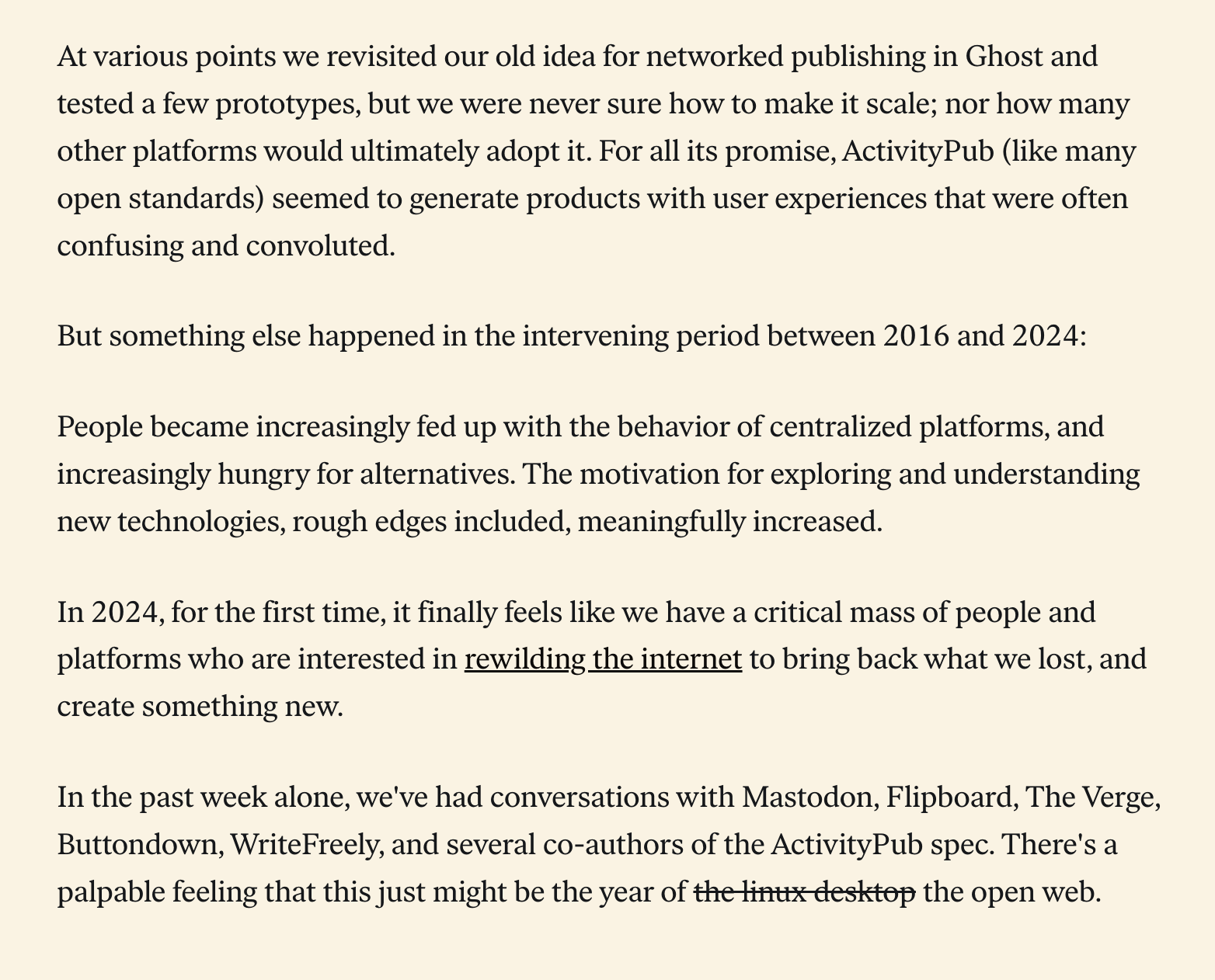
![At various points we revisited our old idea for networked publishing in Ghost and tested a few prototypes, but we were never sure how to make it scale; nor how many other platforms would ultimately adopt it. For all its promise, ActivityPub (like many open standards) seemed to generate products with user experiences that were often confusing and convoluted. But something else happened in the intervening period between 2016 and 2024: People became increasingly fed up with the behavior of centralized platforms, and increasingly hungry for alternatives. The motivation for exploring and understanding new technologies, rough edges included, meaningfully increased. In 2024, for the first time, it finally feels like we have a critical mass of people and platforms who are interested in rewilding the internet to bring back what we lost, and create something new. In the past week alone, we've had conversations with Mastodon, Flipboard, The Verge, Buttondown, WriteFreely, and several co-authors of the ActivityPub spec. There's a palpable feeling that this just might be the year of [begin strikethrough] the linux desktop [end strikethrough] the open web.](https://storage.mollywhite.net/micro/1d5eb382a3faf17a0c4d_Screenshot-2024-05-10-at-12.36.00---PM.png)